Epigenetics: A Playbook for Marine Survival
Reflections
Blog Reflection
Audience, Framing, and Scientific Accuracy
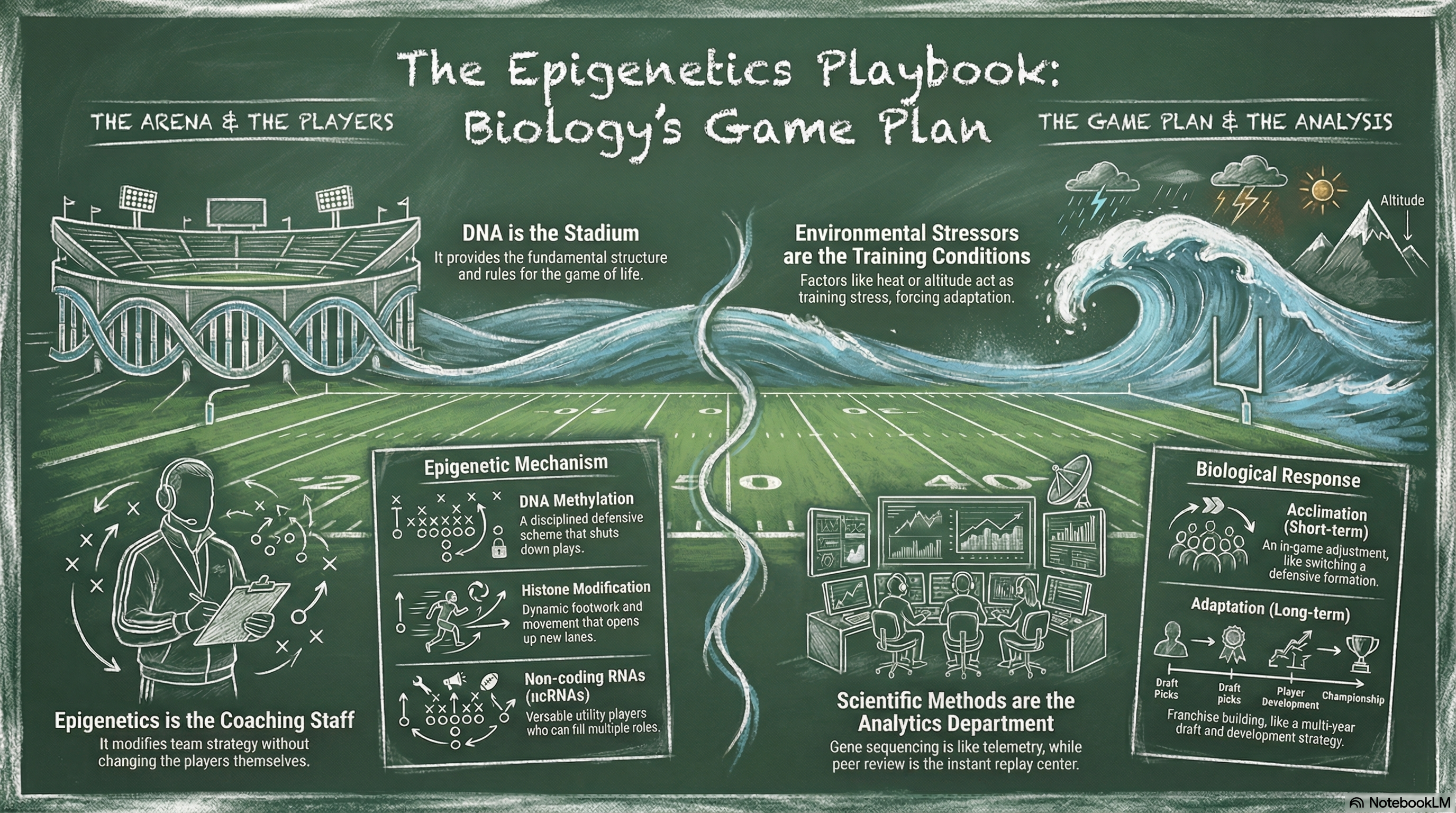
The primary goal of this communication project was to make the complexity of marine epigenetics accessible, engaging, and relatable to a non-expert audience. My intended audience includes community members, students, science-curious readers, and anyone who may not have a formal background in molecular biology but can follow sports narratives, metaphors, and archetypes.
Because marine epigenetics involves dynamic regulatory processes that are challenging to visualize, one of the central decisions I made was to anchor the piece in cultural references that many readers understand; sports, athletes, coaching styles, game strategies, and player analogies. These provide a familiar cognitive framework for readers to map onto the scientific mechanisms. I chose sports specifically because they reflect systems-level coordination: teams, roles, strategies, adjustments, long-term development, and rapid response. These elements align naturally with epigenetic mechanisms such as DNA methylation, histone modifications, chromatin remodeling, and non-coding RNA regulation.
Instead of overwhelming readers with terminology, the metaphors allow them to conceptualize these mechanisms as coaches, players, and scheme adjustments within a game. Sports also carry emotional resonance, making scientific concepts more memorable without diluting accuracy. Framing the narrative with my personal sports identity served two purposes. First, it grounded the post authentically in my voice. A personal anchor can strengthen public-facing science communication by establishing trust and relatability. Second, it created a throughline that “epigenetics is my Super Bowl” not just as a joke, but as a statement about how meaningful and exciting this field is to me. Enthusiasm can be infectious, especially when introducing complex scientific ideas.
In terms of scientific accuracy, I intentionally maintained clarity around what epigenetics is and what it is not. Every metaphor was paired with a scientifically correct description: DNA methylation truly adds methyl groups to cytosines and typically reduces transcription; histone modifications genuinely change the accessibility of DNA wrapped around histone proteins; non-coding RNAs do in fact regulate gene expression post-transcriptionally; chromatin remodeling complexes physically reposition DNA in three-dimensional space. The sports metaphors were used to scaffold, not substitute, scientific detail. I was careful not to conflate acclimatization and adaptation, a common misconception in public discussions of environmental change. The blog post briefly touches on reversible, within-lifetime epigenetic adjustments (acclimatization) from longer-term, cross-generational changes that could contribute to adaptation. Scientific accuracy also guided my description of tools and methods used in marine epigenetics. Rather than implying that researchers “guess” at epigenetic states, I named the actual technologies and explained their relevance. Ultimately, while topical, there are a few places (Coach’s Challenges) where additional, higher- level information can be found. The inclusion of peer review and statistical rigor further reinforced scientific trustworthiness without derailing the storytelling.
Finally, I wanted the post to end with a sense of momentum. Epigenetics is a rapidly evolving field, and framing future research directions as the rise of “expansion teams” and “rookie superstars” delivered a sense of growth and possibility. Ultimately, my goal was to create an engaging piece that communicates core concepts of marine epigenetics while honoring the complexity of the science. The sports theme provided the right balance of accessibility and creativity, and the final piece reflects a deliberate effort to maintain accuracy while reaching a broad public audience.
Read my post here.
Course Reflection
Learning, Research and Feedback
Over the past quarter, this course has deepened my understanding of the many physiological, ecological, and mechanistic processes that underlie aquatic organism function — especially for bivalves — and really put into context just how much remains to be discovered. Through our readings and discussions, I developed a much richer perspective of the multiple epigenetic mechanisms at work as well as the many ways environmental factors modulate those mechanisms. I came away with a clearer sense of not only how these mechanisms operate, but why even small differences among species or environmental context can lead to very different ecological outcomes.
Much of my current and future projects already involve contaminants and fundamental physiology — but the conceptual scaffolding that this course provided gives me a clearer lens to add and interpret our findings in a physiological context through epigenetic analysis. Ultimately, the course’s emphasis on mechanisms gives me conceptual tools to better integrate physiology, ecology, and contaminant dynamics — strengthening the ecological relevance and interpretability of my data.
Regarding course feedback, more notice on final course requirements and greater clarity on how many discussion questions are expected per class. I would have enjoyed participating a bit more in the personal research or ‘cool findings’ posts if I was clearer on the expectation. Moreover, while we read many papers, there was often little time for discussion. Given the complexity of the mechanisms we studied, I think the course would benefit from dedicating some class sessions to student-led discussions or presentations. For example, allowing a student to present one paper aligned with the week’s themes, followed by group discussion, might deepen engagement and understanding more than simply reading multiple articles on one’s own outside of class.
In sum, the course enhanced my appreciation for the subtlety and complexity of epigenetic mechanisms. That deeper understanding has already started paying dividends in my research, helping me frame more nuanced hypotheses. With more transparent course structure and more opportunities for discussion or student-led synthesis, I believe the course could become even more effective.