Guest Lecturing & Complex Mussel Complexes
Guest Lecture
For the second year I was invited to give a guest lecture in the ENVIR 100 class. It was an awesome opportunity to improve my large class skills by applying what I learned lecturing this class last year.
Since the class ranges between 200 - 350 students each quarter, it certainly requires a different level of class content and engagement skills than a 20+ person course.
My talk was about marine conservation and the different ways we can support, develop, or add to current efforts in the PNW marine ecosystem. Absolutely a blast!
Mytilus edulis Complex
- As I continue with my reworking of the combined manuscript, I allowed myself a chance to take a detour into the world of the edulis complex.
- Three Mytilus species can (and do) regularly hybridize, and as a result they are often referred to as the ‘edulis complex’ in broader -omics studies. The big 3: edulis, galloprovincialis, and trossulus, share habitat (trossulus is native to PNW waters and edulis and gallos are introduced), share morphological characteristics so you cannot reliably tell them apart visually, and their genetic ancestry is a Pandora’s box of overlap, heterozygosity, abundant gene copies and significant presence/ absence genes (gallos are leading the pack with this one).
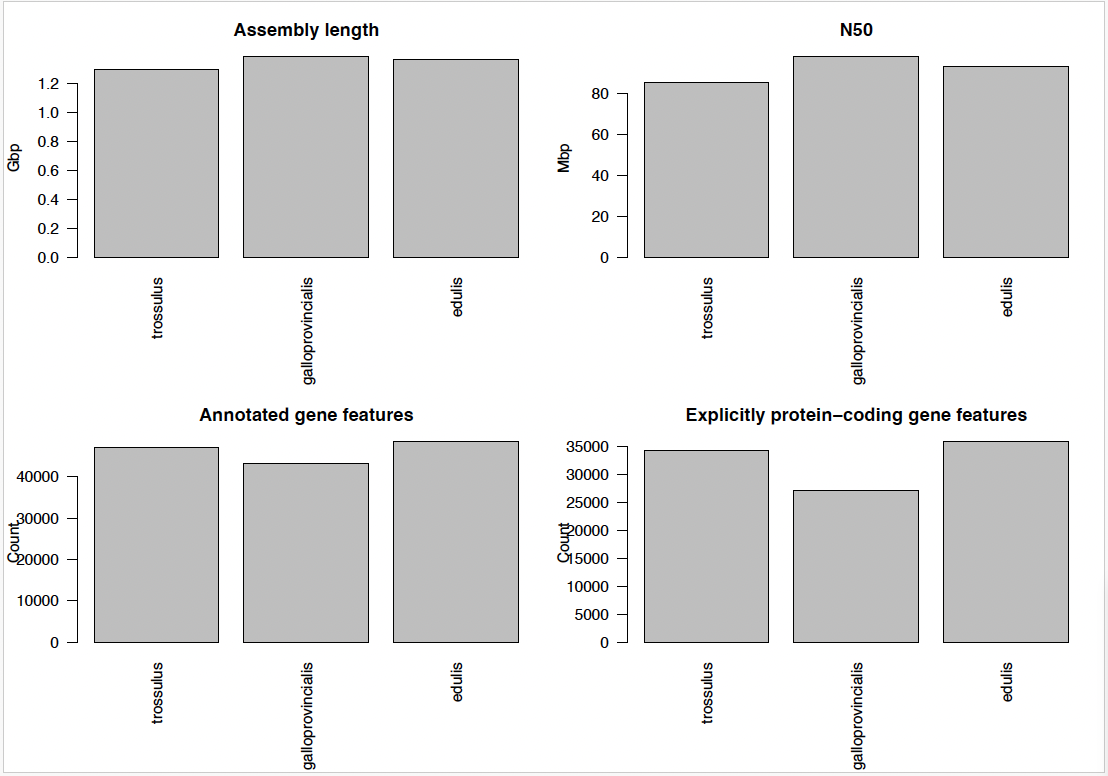
- Because of this, and the differentially methlyated pathways we found, I wanted to compare the NCBI reference genomes for each by assessing size, scaffolds, annotations, and pure number of genes. This line of inquiry is for my own curiosity while I think through the reasons (beyond the processes that were in the gene list for DMLs) for the response.
- With the help of Sam’s Lab Notebook, a couple of my own dusty bash scripts, and ChatGPT, I created an initial assessment pipeline to answer the question of if the three references were comparable to support more significant downstream investigation.
- All of the metadata for this (process and reference genomes) has been kept separately in case I want to pursue further questions or analyses.
- I compared the RefSeq endorsed references for all three and double-checked that all had at least a chromosome-level assembly and gene annotations since several of the marine mussels do not have that at the moment.
- Question answered - there are three comparable references to assess, sufficient metadata to explain sample integrity, and gene annotations available for all three.
- Next, I wanted to see what the general differences were and understand if they could be attributed to assembly or annotation.
- First pass look (plots below) seems pretty decent, so my next step is to run the BUSCO QC process for each rather than relying on truncated QC reports on the NCBI site for each.
- Since this is a ‘support my thinking’, not a ‘create a new path’ project, I stopped here to make my writing notes, think about the baseline reference comparison, and return to drafting.