Setting Up the Week
Plan of the Week: March 9 - 15, 2026
- Working week listed from Mon - Sun
Daily Focus
- Monday: Mapping out the plan of attack for the week
- Tuesday: UW-RUA & Dean’s Office Work
- Wednesday: Lab Meeting & Prep for Thursday’s eDNA ‘think tank’ session and UW-AAF events
- Thursday: eDNA process & literature ‘think tank’ session with Kassi P and Connor, Nanopore and UW-AAF events
- Friday: Writing Accountability with KPJ, focus on Biomarkers
- Saturday: NW Straits Meeting - Ecology/ Conservation/ Public Sessions
- Sunday: Biomarker Manuscript
Plan of the Day
- My goal for today is to plan out the deliverables I have for the week - including the steps for making progress on upcoming deliverables to mitigate the 11th hour push that is getting really old.
- The remainder of the day will be spent prepping UW-RUA materials.
Projects Touched Today
- Mussel Biomarkers
- Proposal Chapters 3 & 4
- Yellow Island
- Lab Notebook
Progress Notes
Planning/ Lab Notebook
- Before setting up my plan for the week, I updated my lab notebook by adding daily log posts for the weekend, archiving February and putting all of those posts into a single file, reviewing my monthly goals, and brain dumping for all projects and tasks.
- Dean Search- ConEv
- I caught up with the Dean candidate search by watching Candidate A’s presentation and providing feedback in the survey.
- I virtually attended Candidate B’s presentaiton and submitted my feedback in the survey provided by the search committee.
Yellow Island
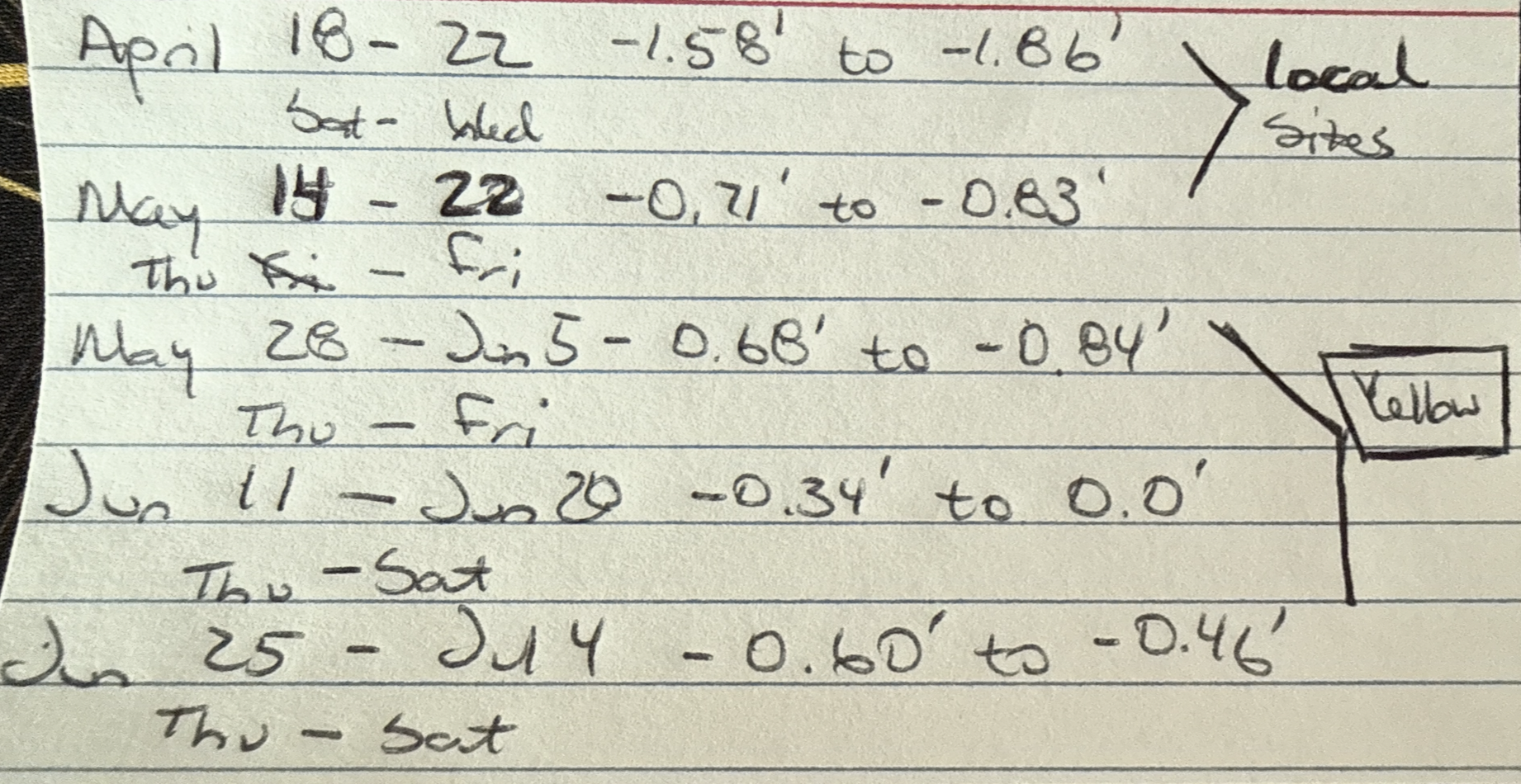
- I sent my requested dates for Yellow Island surveys this spring/ summer. Since my schedule and priorities have shifted, I am able to batch surveys within the longer/ lower low tide series in late May and early June.
Chapter 3 & 4
- I worked through a scaled- down version of the lab experiment for Chapters 3 & 4
- Using the 2021-22 WDFW data, I identified the region’s highest and lowest concentrations of the potential tx chemicals:
- Cadmium (mg/kg) - 0.226 (Arroyo Beach) - 0.416 (Penn Cove), mean= 0.310
- Copper (mg/kg) - 0.774 (Broad Spit) - 5.18 (Chimacum Creek Delta), mean= 1.17
- Sum of 16 PAHs (ng/g) - 3.6 (Hood Canal Holly) - 1600 (Des Moines Marina), mean= 80.74
- Only the 74 sites included in the biomarker work are included.
- Values listed above are the wet tissue values (blank corrected for PAH) with the Detected qualifier only.
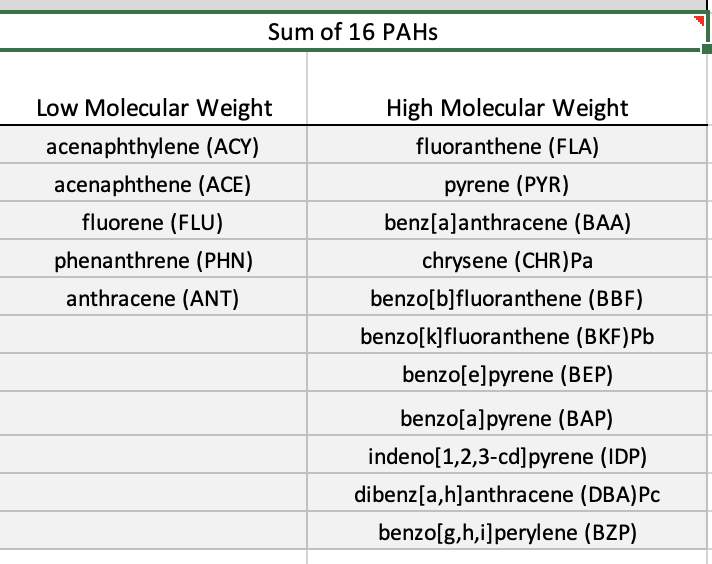
- I used the Sum of 16 PAHs because they are the longest defined PAHs by the EPA for their toxicity to humans. The lowest PAH concentration was at a site not included in the earlier work (Drayton Harbor).
- Using the 2021-22 WDFW data, I identified the region’s highest and lowest concentrations of the potential tx chemicals:
The individual PAHs are listed in the image below - if a mixture is not feasible for experimentation, the high molecular weight PAHs are the most persistent while the low molecular weight PAHs can have higher acute toxicity; considering long- term exposure as the baseline for molecular response, we should prioritize the high weight PAHs.
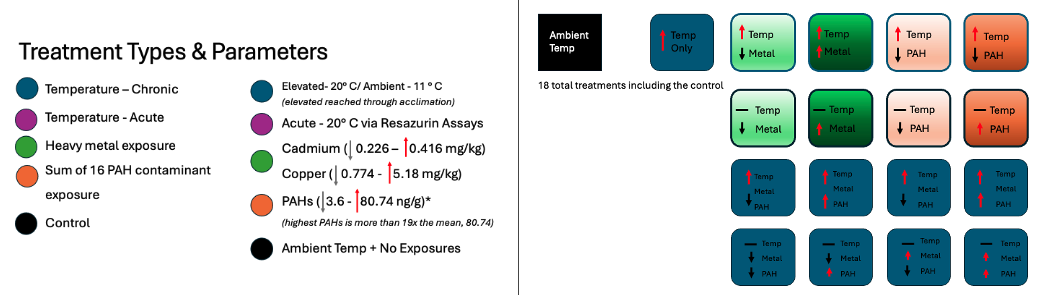
Looking at the experimental design, there are two paths that can be taken regarding elevated water temperatures.
Chronic elevated water temperature at 20° C
Acute elevated temperature exposure through the use of resazurin assays to mimic tidal fluctuations in warmer months.
The general design without resazurin looks like the design below.
Products & Word Count
- Yellow Plan: 50 words + 2 tables/ time schedules with personnel allocation for TNC support
- Chapter 3 & 4 plan: 100 words + diagram/ sketch of tx options
Today’s total: 150 words
Monthly total to date: 1392 words
Annual total to date: 21,845 words
Tomorrow’s Plan
- Tuesday is a UW-RUA day, and likely will include no personal science work.